
 Back to News
The Maltese Olympic Academy, part of the Maltese Olympic Committee, hosted the 8th Congress of the European Olympic Academies (EOA) in Malta from 15 to 18 November, concluding today with the 9th EOA General Assembly.
Held under the theme “Reflections, Exchanges and Outlooks: Bringing Together the NOAs of Europe”, the Congress marked eight years of the European Olympic Academies and welcomed delegates from National Olympic Academies (NOAs) across 36 European countries, providing a network between them and sharing good practice across its membership.
The Congress was officially opened on Sunday with addresses by Julian Pace Bonello, President of the Maltese Olympic Committee; Jose Manuel Araujo, Chair of the EOC Culture and Education Commission; Prof. Dr Charilaos Tsolakis, President of the International Olympic Academy; and Prof. Dr Manfred Laemmer, President of the EOA.
The first day of sessions focused on the work of NOAs in Europe. Following a keynote by Soenke Schadwinkel evaluating the academies after two EOA terms, academies from Greece, Ukraine, the Netherlands, the Czech Republic, Romania, Austria, Serbia and Malta presented their projects and achievements. Charles Camenzuli presented on behalf of the Maltese Olympic Academy, looking beyond Malta’s first Olympic participation. The afternoon turned to the place of athletes in the Olympic Movement, with keynotes from Jose Manuel Araujo of the EOC and Leo Koepp, board member of the German athletes’ association Athleten Deutschland. Parallel workshops then explored the use of AI in the day-to-day operations of NOAs, athlete participation in sports governance, and the links between Theodorus Antonides’ 1732 book Olympia and modern Olympism.
That evening, delegates gathered in Mdina for the Gala Dinner, where David Azzopardi, Chair of the Maltese Olympic Academy, delivered the keynote address. The evening also included the EOA Flame Awards and the signing of a Memorandum of Understanding with the African Association of Olympic Academies (AANOA).
On Tuesday, the Congress turned to contemporary Olympic debates. Maria Bogner, Head of the IOC Olympic Studies Centre, spoke on Olympic education and studies; Raymon Blondel, President of the European Paralympic Committee, on the Olympic and Paralympic Movements; Carlotta Giussani, Director of the EOC EU Office in Brussels, on Erasmus+ projects; and Dr Lara Tonna on university students’ perspectives on Olympism and Olympic education. The Israeli NOA also presented its work on education and social impact through Olympism. Workshops on Olympic education and on storytelling and Olympic heritage followed, drawing on the Erasmus+ opportunities presented earlier, before delegates visited Valletta for a guided tour of the city and harbour.
The General Assembly elected a new seven-member Executive Board for the next four years, made up of a President, two Vice-Presidents, a General Secretary, a Treasurer and two board members. Alexandr Kliment of the Czech Olympic Academy was elected President after three rounds of voting. He succeeds Prof. Manfred Laemmer of the German Olympic Academy, the EOA’s founding President, who served two terms and did not seek re-election. In his first remarks, Kliment said that every academy is equal and equally important, and set out his aim to connect members’ experience, develop joint projects and welcome new countries into the EOA.
Edmund Mifsud, a member of the Maltese Olympic Academy commission, was elected to the Executive Board as one of two Vice-Presidents, alongside Eda Caushi of the Albanian Olympic Academy.
The new Executive Board is completed by Lilla Szijj (Hungarian Olympic Academy) as General Secretary, Sakina Valiyeva (National Olympic Academy of Azerbaijan) as Treasurer, and board members Evghenii Draganov (Moldovan Olympic Academy) and Dimosthenis Tampakos (Hellenic Olympic Academy).
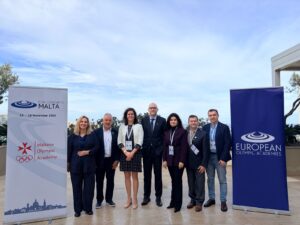
David Azzopardi, Chair of the Maltese Olympic Academy, said: “It was a privilege for Malta to welcome colleagues from academies across Europe. The Congress was a fruitful one, with good discussion in the workshops and plenty of opportunity for delegates to exchange ideas and build links that will benefit Olympic education in all our countries. I would also like to congratulate Edmund Mifsud on his election as Vice-President. It is well deserved, and it is a recognition both of his own commitment and of the work of the Maltese Olympic Academy.”
The Maltese Olympic Academy thanks Visit Malta and Sport Malta for their support in hosting the Congress and General Assembly.